July 2026
Inside This Issue

July brings several Joint Commission updates that affect accreditation planning, performance measurement, laboratory operations, and cybersecurity preparedness. This month’s issue of the Patton Post highlights the most significant announcements and explains what hospital leaders should review as part of ongoing survey readiness.
 New Standalone Accreditation Program for DMEPOS Suppliers:
Beginning September 1, 2026, Joint Commission will offer a standalone accreditation program for durable medical equipment, prosthetics, orthotics, and supplies (DMEPOS) providers using Joint Commission accreditation for Medicare enrollment. The new program reflects CMS requirements issued in the 2026 DMEPOS/Home Health Final Rule. While the applicable accreditation standards have not changed, CMS now requires on-site accreditation surveys every 12 months rather than every three years for affected suppliers. Organizations using Joint Commission accreditation for Medicare enrollment should review the new program requirements and determine when their annual survey cycle will begin.
Many health systems oversee DMEPOS operations in addition to hospital accreditation activities. If your organization manages DMEPOS accreditation, verify whether the supplier uses Joint Commission accreditation for Medicare enrollment, identify the new annual survey cycle, and communicate the changes with operational leaders responsible for DME services.
 Optional System Survey for Laboratories:
Effective July 1, 2026, Joint Commission introduced an optional laboratory system survey for healthcare systems seeking accreditation or reaccreditation. Eligible organizations may combine multiple laboratory surveys into one coordinated system survey, reducing planning burden. Organizations must meet at least five of nine operational integration criteria to qualify.
Health systems with multiple accredited laboratories should review the eligibility criteria and determine whether a coordinated survey would benefit their organization. Standardized policies, centralized oversight, and consistent quality practices will be important considerations when evaluating this option.
 2027 ORYX Requirements Remain Unchanged:
Joint Commission announced that ORYX performance measurement requirements for hospitals and critical access hospitals will remain unchanged for 2027. Organizations should continue current reporting processes while monitoring future updates.
For most organizations, this announcement means there are no new ORYX reporting requirements to prepare for next year. Quality and regulatory leaders can continue refining existing data collection and performance improvement processes while maintaining focus on current reporting expectations.
 Cyber Resilience Readiness Program Expands:
Joint Commission and the American Hospital Association have expanded the Cyber Resilience Readiness (CRR) program with three voluntary components: a free self-assessment, optional advisory services, and Joint Commission Cyber Resilience certification. The program is designed to help hospitals evaluate their ability to maintain safe clinical operations during cyber-related technology outages.
The free self-assessment provides organizations with an excellent opportunity to perform a structured gap analysis of their cyber resilience and operational continuity plans. Hospitals should consider involving information technology, emergency management, clinical operations, and regulatory leaders in reviewing the assessment results and identifying opportunities for improvement.
 Impact 360 Resources Continue to Grow:
Joint Commission continues to expand its Impact 360 resources with additional educational materials focused on high-level disinfection (HLD) and sterilization. New resources include tracer observation forms and on-demand educational webinars. Sentinel Event transition webinars are also available to help organizations prepare for changes taking effect in January 2027.
Organizations should investigate and take advantage of the Impact 360 resources and incorporate the tracer tools, webinars, and performance examples into their ongoing survey readiness and performance improvement activities.
 Physical Environment Survey Process:
The July EC News includes a comprehensive seven-page overview of the Physical Environment survey process under Accreditation 360. While too detailed to summarize here, the article walks readers through the survey from start to finish, including survey logistics, required documentation, building tours, survey findings, and available preparation tools. It also introduces resources such as the Hospital Accreditation Survey Process Guide and explains how surveyors use the SAFER® Matrix and the new SAFEST™ initiative as a prep tool.
Many hospitals have experienced significant turnover in Facilities leadership over the past several years. This article is an excellent primer for new Facilities directors, Environment of Care leaders, Accreditation professionals, and anyone preparing for their first Joint Commission survey. We recommend sharing it with new facilities and regulatory leaders as part of their onboarding and using the referenced survey tools to evaluate your organization’s readiness before the next survey.
 Safely Implementing Metal Detection:
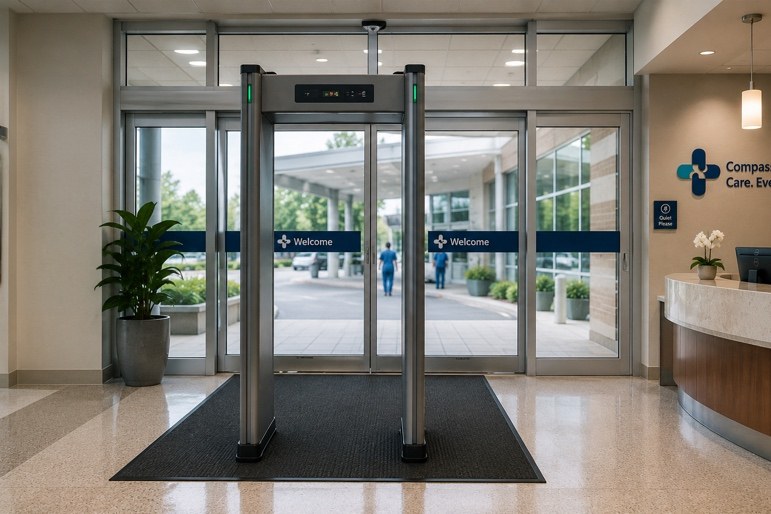
As more healthcare organizations evaluate metal detection systems in response to workplace violence concerns, the July EC News provides practical guidance on issues organizations should address before implementation. The article focuses on planning considerations such as maintaining required means of egress, managing visitor flow, selecting appropriate technology, developing screening procedures, training staff, and coordinating with Facilities and Security leaders. It also discusses a recent NFPA tentative interim amendment related to weapons detection systems and egress.
Many hospitals are evaluating or expanding weapons detection programs. This article serves as a useful planning resource for organizations early in that process. Before implementing new screening technology, involve Facilities, Security, Emergency Management, and Regulatory leaders to evaluate traffic flow, emergency egress, staffing, maintenance, and policy requirements. A well-designed screening process should enhance security without creating unintended life safety risks.
 Laundry Operations Continue to Be a Survey Focus:
The July EC News includes a comprehensive Q&A addressing Physical Environment requirements for laundry processing, linen storage, and soiled linen handling. Rather than introducing new requirements, the article serves as a helpful reminder of existing Life Safety Code, ventilation, equipment maintenance, and infection prevention expectations that surveyors routinely evaluate. Topics include sprinkler clearance, corridor storage, hazardous area requirements, ventilation relationships, and inspection and maintenance of laundry equipment.
Laundry operations involve multiple departments, including Facilities, Environmental Services, Infection Prevention, and Safety. This article is a good refresher for organizations preparing for survey and can be used as a checklist when conducting Environment of Care rounds. Periodically reviewing laundry areas helps identify common compliance issues before surveyors do.
 Emergency Generator Compliance Checklist:
Emergency generators remain one of the first utility systems evaluated during the Physical Environment survey. The July EC News introduces a new Emergency Generator Compliance Checklist that outlines the required inspection, testing, and maintenance activities for emergency power systems, including weekly, monthly, annual, and triennial requirements. While Joint Commission does not require organizations to use the checklist, it provides a consolidated reference for generator compliance activities.
Emergency power systems continue to be a frequent survey focus. Even organizations with well-established preventive maintenance programs may find the checklist useful when validating generator testing schedules, documentation, fuel quality records, and inspection activities. Consider using the checklist as part of an internal Environment of Care audit or survey readiness assessment.
 ACHC Responds to CMS Final Rule:
While Joint Commission has not released a public statement regarding how the CMS Final Rule on Accrediting Organization oversight and consulting restrictions will affect its fee-based consulting or other operations, ACHC has published an overview for its accredited organizations. ACHC states that the rule will have minimal impact on its accreditation programs because many of the requirements are already in place.
ACHC also notes that it will strengthen its conflict-of-interest policies and is seeking CMS clarification regarding the scope of the new fee-based consulting restrictions. ACHC reminds organizations that independent third-party consultants such as Patton/Barrins remain available during periods when accrediting organizations are restricted from providing consulting services.
 DNV Highlights Growth of ASC Accreditation:
DNV Healthcare announced that the first ambulatory surgery center (ASC) accredited through its ASC accreditation program has received Medicare certification, marking a milestone for the program. DNV expects continued growth in ASC accreditation as outpatient surgical services expand and organizations seek accreditation options that support Medicare participation.
QSO Memo on Accrediting Organization Final Rule:
Last month, we highlighted the CMS Final Rule strengthening oversight of Accrediting Organizations and the new restrictions on accreditor-provided consulting services. CMS has now issued QSO-26-10-ALL, providing formal guidance to Accrediting Organizations and State Survey Agencies on implementation of the Final Rule. The QSO does not introduce significant new requirements but reinforces the implementation timeline and CMS expectations as organizations prepare for the rule’s effective date of June 16, 2027.
Organizations that work with deemed accreditors should continue monitoring communications from their accrediting organization regarding implementation of the new conflict-of-interest and consulting restrictions.
 Patton Healthcare Consulting has always been built on a commitment to practical guidance, trusted relationships, and helping healthcare organizations achieve lasting success. While this chapter marks the retirement of Jennifer Cowel and Kurt Patton from their day-to-day leadership roles, it also reflects years of thoughtful succession planning and continued investment in our future.
As we’ve shared in recent issues of The Patton Post, we’ve welcomed experienced healthcare leaders whose expertise strengthens the support we provide to clients nationwide. Together with our long-standing leadership and consulting team, they ensure Patton continues delivering the trusted guidance, practical solutions, and client-focused service our partners have relied on for nearly two decades.
Jen and Kurt’s legacy extends far beyond their titles. Their leadership helped shape the culture and values that continue to guide our work every day. We thank them for their extraordinary contributions and wish them both every happiness in this well-earned next chapter.
 Operational Excellence
 Operational Excellence
Transforming Performance. Strengthening Outcomes.
Strong organizations don’t just prepare for survey—they build systems that support long-term success.
Patton Healthcare Consulting partners with healthcare organizations to improve performance, strengthen processes, enhance patient safety, and build sustainable operational improvement.
Our consultants help organizations:
- Improve operational performance and efficiency
- Strengthen quality and patient safety
- Optimize workflows and key processes
- Build sustainable strategies for long-term success
Learn more about our Operational Excellence services or contact one of us below!
Contact Our Team
Julia Finken, RN, BSN, MBA, CPHQ, CLSSMBB
julia.finken@hbsinc.com
Kathy Eichner, RN, MSN, CPHQ, CJCP
kathy.eichner@hbsinc.com
Laurie Farmer, MSN, RN
laurie.farmer@hbsinc.com
Dr. Linda M. Shepherd, DNP, MBA, BSN, RN, NEA-BC, FAAN
linda.shepherd@hbsinc.com
John Berry, RN, MSN, SQIL
john.berry@hbsinc.com
John Rosing, MHA, FACHE
johnrosing@pattonhc.com