February 2026
Inside This Issue

Goodbye to Perspectives:
 Perspectives has announced that its February edition will be its final issue. The Joint Commission has indicated it will launch a new communication channel, Joint Commission News, which will be available to accredited organizations at no cost, similar to Perspectives. While the transition represents a notable change, limited detail has been shared regarding the underlying rationale. Historically, Perspectives was published through Joint Commission Resources (JCR), rather than directly by the accreditation arm of the Joint Commission. Importantly, as standards, policies, and accreditation-related updates continue to evolve, Joint Commission News is expected to serve as a key resource for keeping organizations informed.
NFPA Requirements 2026 Standards Updates:
 The February issue of Perspectives does discuss another round of edits to the new 2026 standards that they attribute to NFPA changes. In looking at the hospital manual the first modification is at MM.16.01.01, where they add a new Note 1 to the first EP that contains the requirement that used to be in EP 2, to administer medications by or under the supervision of nursing personnel. This does not appear to be related to NFPA requirements, but rather a continuing consolidation of the number of elements of performance by creating multipart elements of performance. As this is routine nursing practice and already embedded in CMS and most state regulations, this should not create a need for any changes in practice or modifications of existing policies.
 PE.04.01.01 appears more significant where they eliminate Note 3 of EP 1 that required: “All inspection activities to be documented with the name of the activity, date of the activity, inventory of devices, equipment, or other devices, required frequency, name and contact information of the person who performed the activity, NFPA standard referenced by the activity, and the results of the activity.” This requirement, relative to fire safety systems testing had been around for many years in EC.02.03.05, EP 28 and it has been a frequently cited omission at many hospitals. It appears as if the 2026 consolidation of elements of performance inadvertently expanded the requirement beyond just fire safety systems. A more narrowly focused version, limited to fire safety systems has been added back. The newly edited requirement now states that all fire and smoke detection and alarm or extinguishment testing have this detailed documentation rather than all inspection testing. They also created a new Note 2 stating that other inspection, testing and maintenance be done in accordance with manufacturer’s instructions for use (MIFU), or in accordance with established alternative equipment testing processes. It is likely that many organizations had not yet expanded their documentation of inspection, testing and maintenance (ITM) of all equipment, so there should not be a lot of work to undo, however the new EP 2 requiring analysis of MIFU may require some effort.
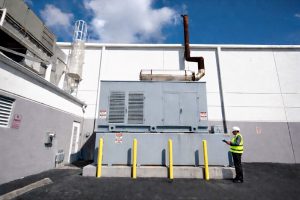 PE.04.01.03, EP 3 is minimally revised to add a new Note 1 that appears to be duplicative of the requirement already in the EP itself. The EP already states that hospitals must meet the emergency power and generator requirements of NFPA 110-2010 and NFPA 101-2012. The new Note 1 added to the EP states that hospitals must implement the requirements of NFPA 110-2010 and NFPA 101-2012. We are not sure how you could meet but not implement the requirements for emergency power and generator testing, but it must have seemed like a vulnerability to someone at CMS or Joint Commission. The more problematic issue with this requirement has been described in EC News and our Patton Post newsletter the past few months, reminding readers that the detailed expectations for emergency power and generator testing have been deleted from the standards and hospitals must refer directly to the NFPA references for guidance. The burden is still present and quite significant; however, it is not a burden originating from JC, it originates from NFPA and both CMS and JC require compliance with the detailed NFPA expectations.
RC.11.01.01, EP 6 has been slightly modified relative to discharge summaries from a psychiatric hospital setting. The new content requires that a discharge summary must include a “recapitulation of the patient’s hospitalization.” This has been an existing requirement in the CMS B-Tag 133 for psychiatric hospitals for many years and should already be established in policies.
Each affected accreditation program has a specific document on the prepublication area of the Joint Commission website, and the Perspectives article includes a link to the edited sections. JC indicates that the effective date for these edits is March 1, 2026. This last issue of Perspectives also includes promotional content for Joint Commission’s continuous engagement model and a new learning program developed by JC and NAHQ. So, we say goodbye to Perspectives and look forward to similar updates being discussed in Joint Commission News in the future.
Surgical Fires:

The lead article in the February issue of EC News has a great refresher article on prevention of surgical fires. They include some actual examples of surgical fires that have been reported and the conditions that were believed to have led to these fires. They also provide detailed guidance on preventative practices to help reduce the risk of surgical fires. Most importantly, EC News again brings home the details that used to be in the standards that are derived from NFPA references, including guidance on surgical area fire drills that are not specifically mentioned in the 2026 standards manual, but remain NFPA expectations where hospitals must be compliant. We would strongly advise sharing this article with your operating room leadership and facilities management and using it as a resource in refining your prevention and drill activities.
 Hazardous Chemicals and Eyewash Stations:
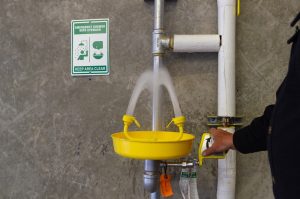
EC News has an equally good refresher article on handling hazardous chemicals and establishing and maintaining appropriate eyewash stations. This issue is very frequently scored noncompliant by JC and seen very often on our consultative surveys. The issues we commonly see include:
- Corrosive or other chemicals which require an eyewash in use in locations without an eyewash
- An eyewash is present but the eyewash:
- Has not been inspected weekly
- Access is blocked by equipment or furniture
- Access is blocked by a locked door
- Distance to the eyewash is too remote from chemical use area
- The eyewash is not plumbed and cannot provide 15-20 minutes of flushing
- The eyewash does not provide tepid water
- The caps are off the eyewash, and the outlet is grossly contaminated
- Staff don’t know how to use the eyewash
We also sometimes note an eyewash present in a location where hazardous chemicals are no longer in use. Conversely, we also see newly introduced hazardous chemicals in use, either independently purchased by the work area, or brought in by contractors such as a cleaning service. We suggest sharing this EC News article with your safety, facilities and EOC committee and more importantly assessing your risks for one or more of these common flaws. Also take a look at your last JC report to determine if this was a prior finding, as you don’t want it to reappear on your next survey.
 Kitchen Tracer:
The third refresher article is on kitchen safety issues that will be examined by life safety code specialists, and it provides what are now the missing details from the NFPA standards that have been deleted from the JC standards. Do take a look at this article and use it in conjunction with the kitchen tracer tool contained in the 2026 Survey Process Guide (SPG). The kitchen tracer tool provides issues to examine, and the EC News article provides detailed explanations of what and why these issues are of importance.
 Accreditation Process Chapter (ACC):
Now that the manuals are online and include all the policy and process chapters, not just the standards, we suggest reading The Accreditation Process (ACC) chapter. This chapter includes what are called decision rules, or the rules Joint Commission will follow if you encounter significant problems on survey leading to any form of adverse decision. This is a chapter in the manual that most organizations never read until an adverse outcome occurs. It is best to know what is instore for you if some adverse decision should occur and the ACC chapter’s decision rules spell out exactly how things proceed and how they can escalate if you are not successful in clearing an issue. For example, if you have condition level findings, you get a Medicare deficiency survey and if you fail to clear that Medicare condition, you have a second Medicare deficiency survey. If you are not successful with that second survey CMS will be informed and evaluate your organization and your accreditation status will be downgraded to accreditation with follow up after CMS clears you to proceed again with Joint Commission. It is by no means a fun read, but it is informative and may help you to focus colleagues on preventing any adverse situations rather than facing the downward spiral of additional consequences from repetitive failures.
 DNV: They are offering a webinar on February 19th entitled “Operational Excellence through Effective Management Systems.” Information about this program can be obtained using their Events page.
ACHC: In January, ACHC posted a resource “DMEPOS Update” for providers of durable medical equipment, prosthetics, orthotics and supplies, or DMEPOS. There was a new CMS final rules for these providers posted 12/2/25 and ACHC has provided a concise summary and explanation of the final rules for providers.
 Excepted Activities:
On February 2, 2026, CMS published QSO 26-04 addressing what activities would continue and what activities would not continue in the event of another government shutdown. CMS again describes what they call “excepted activities,” meaning those activities that are permitted to continue and those that are not. For example, investigations of potential immediate jeopardy situations can continue, but lower level complaint investigations would not. Initial surveys would not be conducted, and certification processing of initial Medicare surveys conducted by accreditors would not be processed by the states. Follow up visits necessary to prevent provider terminations may also continue.
CONSULTANT CORNER
Dear Readers,
As the industry landscape continues to evolve, the right partner matters. Our team brings deep accreditation and regulatory expertise, real-world operational experience, and a practical, collaborative approach to supporting organizations like yours. We work alongside your teams to turn requirements into actionable, sustainable improvements. We’d welcome the opportunity to connect—contact us to start the conversation.
Thank You!
Julia Finken, RN, BSN, MBA, CPHQ, CLSSMBB
Julia.finken@hbsinc.com
Jen Cowel, RN, MHSA
jencowel@pattonhc.com
Yvonne Rockwood, MBA, MHA, CPHQ
yvonnerockwood@hbsinc.com