June 2026
Inside This Issue

 Home Health Changes:
Joint Commission’s new publication discusses two new elements of performance applicable to home health agencies that use their accreditation for deemed status. These changes are due to CMS regulatory changes and are applicable July 1, 2026. The modified standard is LD.04.03.03 which now contains two new EPs, 36 and 37.
EP 36 requires organizations to develop, implement and maintain through an annual review, a patient acceptance to service policy. The policy needs to be applied to all new patients being evaluated for home health care and to discuss in detail the agency’s ability to provide the services needed by that patient. The discussion of the agency’s ability should include reference to the agencies case load and staffing levels.
New EP 37 further details the requirements to publicly disclose the agency’s capacity and limitations to provide specialty services that may be needed by the patient. For further details take a look at the JC Standards prepublication page and/or the CMS regulations at 42 CFR 484.105(i). Again, these new requirements take effect this July.
 Office-Based Surgery Changes in Alabama:
The State of Alabama has developed new rules for office-based surgery (OBS) programs and will require accreditation for such programs. They have created three (3) practice levels of office-based surgery, the first of which requires no registration, level II which includes moderate sedation, and level III which includes deep sedation or general anesthesia.
Alabama’s board of medical examiners has stated that any use of propofol is automatically classified as level III. These new requirements are only applicable in Alabama and only applicable to office-based surgery programs, but they do show one state’s perceptions on the use of propofol.
 Serious Reportable Event Update:
In March, Joint Commission and the National Quality Forum (NQF) published new guidance on serious reportable events. That document has now been updated to include refinement to SRE 7. An updated version of the document has been posted to the Joint Commission website, and a link is provided in JC News.
It is somewhat confusing when you first take a look at the updated document because it includes the prior “NEW” SREs still highlighted in orange as new, plus the new text modification to SRE 7. The best way to understand what changed is to print SRE 7 from the March and May documents and be sure to change your definitions in accordance with the May update.

Perinatal Hypertension Measure:
Joint Commission has developed a new eCQM perinatal hypertension measure, PC-08 that optionally can be utilized for 2026 and 2027 ORYX requirements. JC is also conducting a webinar on June 25 to detail the measure, and a link is provided in JC News if you wish to participate.
Behavioral Health Standards Compliance:

Behavioral Health accredited providers and hospitals with psychiatric services will want to study the article in this month’s Joint Commission News where they discuss high risk, problematic standards that are often scored noncompliant on surveys. As you might anticipate issues related to suicide prevention are high on the clinical list.
Specifically, lapses ranked by Joint Commission highest using their SAFER Matrix include problems with:
- Suicide risk assessment
- Environmental risk assessment
- Suicide risk screening
- Use of standardized tools to inform the treatment plan
- Nutrition screening
The issues ranked highest from an environment of care perspective include problems with:
- Utility system control labels
- Fire drill critiques
- Monthly emergency lighting tests
- Maintenance of low risk medical equipment
- Safe and suitable environment
The article then includes examples of specific issues that are often seen by surveyors in these areas. In addition to sharing this article with behavioral health leaders you may want to consider internally evaluating your own compliance rates and adequacy in the level of detail matching the performance measures you are currently collecting in these areas.
 Smoke and Fire Barrier Penetrations:
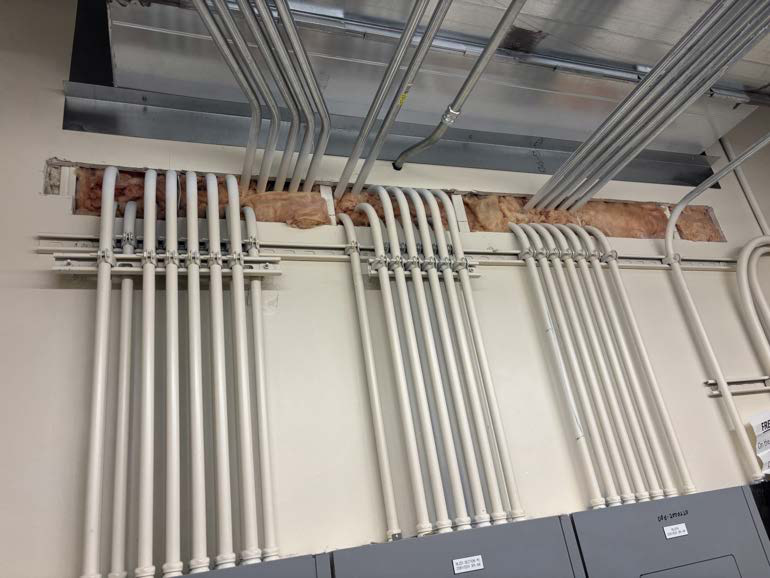
The lead article in this month’s edition of EC News is about sealing smoke and fire barrier penetrations. Flaws in sealing penetrations have been frequently scored on accreditation surveys since long before anyone practicing in healthcare today first graduated and began to work in a health care facility.
The author does a great job of describing the multiple different fire sealant materials that are available today and the settings/areas in which different products should be used, in specific settings. Readers may find it helpful to develop product specifications as well as policies and procedures for these different settings and use this guidance when bidding for contractors to perform renovations or repairs.
Most healthcare facilities have been in operation for many years and over those years a multitude of staff and contractors have been drilling holes in walls and floors to run pipes or cables to create risk that the wrong product was used or inadequately applied. Preventing that risk from growing each year may be a useful exercise.
 Physical Environment Considerations for Dialysis Centers:
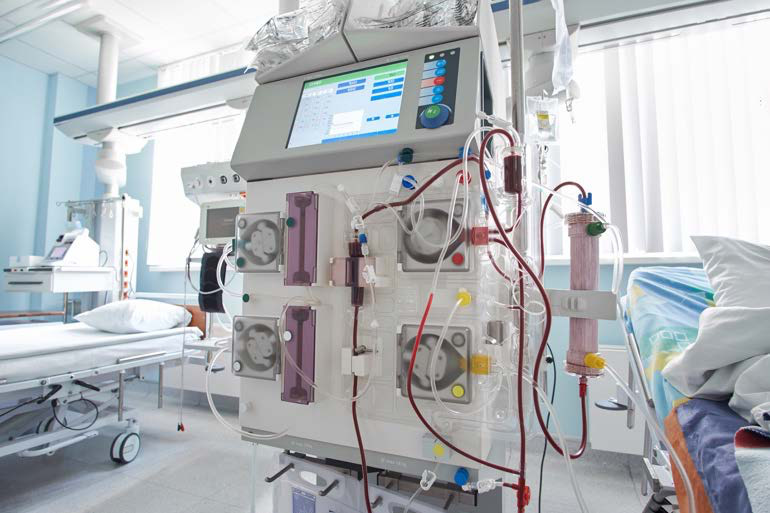
EC News also contains a helpful and timely article on maintaining the physical environment in dialysis centers. We say timely, because in our CMS section we discuss the new CMS State Operations Manual or appendix H for end stage renal disease/dialysis providers. This EC News article helps provide insight on some potential vulnerabilities in the physical environment and equipment maintenance areas such as wall boxes. This ties in nicely with several of the CMS surveyor task documents and checklists for survey, and highlights risk areas worthy of your focus.
 Fire Safety Equipment ITM:
Lastly, EC News has a brief article on maintaining fire safety equipment. It promotes a new book they have produced, but they include a link to an inspection checklist they have included in the book that reminds readers to the frequency for conducting inspections on about 40 different unique pieces of fire safety equipment.
 DNV: IT Security Webinar:
DNV has posted a link for a webinar they are conducting on information technology security, and more specifically, using ISO 27001 standards to achieve security. The webinar is being held on June 25th, and you can register if interested.
 Accrediting Organization Final Rule:
While it is not a QSO, CMS has posted an important document in the Federal Register discussing oversight of accrediting organizations (AOs). You might recall the 2017 article in Wall Street Journal on perceived conflict of interest and a 2024 posting where CMS discussed potential limitations on fee based consulting by CMS deemed accreditors. That 2024 posting seemed to just evaporate, but that is apparently not the case. We have been hearing rumors for several months that this was being revisited, and we have observed JC doing some reorganizing such as moving their official newsletter from their consulting arm back to the accreditation side.
On June 16 CMS posted a final rule with comment period on increasing oversight of deemed accreditors. One such oversight modification is a prohibition on accreditors performing consultation surveys within a year of an organizations next scheduled survey. CMS is also prohibiting accreditor linked consulting firms from performing any initial survey consulting or complaint survey consulting. CMS has also defined firewall protection policies between an accreditor and its consultation side. The posting also discusses conflict of interest restrictions and reporting requirements to CMS on implementation of their conflict policies.
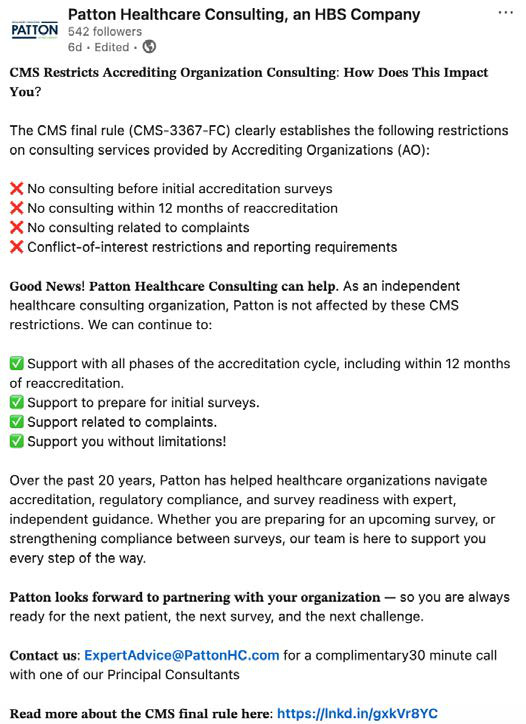
We are fortunate at Patton Healthcare Consulting that we are a consulting only firm and thus are not subject to any of these restrictions. Our consultation is designed to help organizations understand regulations/standards, design safe and effective care delivery practices, that simultaneously embed both CMS and accreditor standards. We are also fortunate that over the past 20 years we been able to recruit many former colleagues from accreditors to join us and that trend is accelerating as a many of the best and the brightest stars that we once worked with at these AOs have recently been able to join us at PHC. We look forward to continuing our relationships with existing clients and acquiring new clients who don’t want to be periodically cut off from consultation support during the accreditation cycle or at time of need, following a complaint.
We have highlighted the key takeaways in our LinkedIn post.
If you have questions about how these changes may affect your organization, please reach out for a complimentary 30 min consult with one of our Principal Consultants. We also encourage you to follow us on LinkedIn, where we regularly share timely accreditation, regulatory, quality, and compliance updates.
 End-Stage Renal Disease Providers:
On May 15 CMS posted QSO 26-09 regarding guidance for providers of care for end-stage renal disease (ESRD). This memo will become the state operations manual for evaluating ESRD providers and be named provider Appendix H. The QSO memo itself is only three (3) pages, however the attached Appendix H is 420 pages. CMS uses their customary process of noting changes in red making a scan of the new material somewhat easier, although it is still a long and complex document.
Appendix H is helpful to providers to know what CMS state surveyors will do during a survey and the new appendix highlights multiple tasks that should be studied such as:
- Task 1: Presurvey preparation, or the information surveyors will review about your organization prior to arrival.
- Task 5: Observation, or the things surveyors should be looking at.
- Task 7: Water treatment room, or the things and practices surveyors will evaluate regarding proper water treatment.
- Task 8: Dialysate reprocessing
- Task 9: Dialysis equipment maintenance or the quality control practices to keep the equipment functioning safely.
- Task 11: Medical record review, or the documentation surveyors are advised to carefully examine.
- Task 12: Patient interviews, or questions surveyors might ask of patients.
- Tasks 13 and 14: Personnel record reviews and personnel interviews, or the things staff may be asked to discuss and the supporting documentation for competency.
The new Appendix H also includes surveyor tools that ESRD providers, quality, engineering and infection prevention staff can use to assist in evaluating overall compliance. These surveyor worksheets include:
- ESRD Core Survey Data Worksheet
- Entrance Conference Worksheet
- Observations of Hemodialysis Care and Infection Control Practices Worksheets
- Patient Sample Selection Worksheet
- Water Treatment and Dialysate Review Worksheet
- Dialyzer Reprocessing/Reuse Review Worksheet
- Dialysis Equipment Maintenance Review Worksheet
- Home Dialysis Training and Support Review Worksheets
- Patient Interview Worksheets
- Personnel Record Review Worksheet
- Personnel Interview Worksheets
- Medical Record Review Worksheets QAPI Worksheet
 Home Health and Hospice:
On May 20, 2026, CMS posted a second QSO-26-11. You may have read recent media reports on potential fraud in the home health and hospice industry in California. This memo addresses all home health and hospice providers, and it indicates that CMS is imposing a 6-month moratorium on new provider approvals. CMS will not be conducting any initial surveys to approve new providers.
Accreditors, if the perform an initial home health or hospice survey, those surveys will not provide any deemed status recognition for Medicare. CMS indicates that no individual exceptions can be approved, except in the event of a federally declared disaster. CMS did indicate that applications submitted prior to May 13 will continue to be processed.
Dear Readers,
This month brings both an important industry development and continued growth for our team.
As discussed in the previous CMS section, CMS recently released its Accrediting Organization Final Rule, introducing new restrictions and oversight requirements for accrediting organizations and their affiliated consulting activities. While these changes will impact portions of the healthcare consulting landscape, Patton Healthcare Consulting and Barrins and Associates remains uniquely positioned as an independent consulting firm dedicated solely to helping healthcare organizations achieve and sustain excellence.
Over the past several years, we have been fortunate to welcome many highly respected healthcare leaders, former accreditor experts, and experienced consultants to our team. That momentum continues as we welcome Mary Kay Bowie, RN, BSN, MHSA, CPHQ, Client Engagement Leader and Cynthia Battista MS, Director of Contracts and Client Engagement to the HBS, Patton, and Barrins family.
Their addition further strengthens the expertise available to our clients alongside our Principal Consultant team, including Laurie Farmer, MSN, RN; John Berry, RN, MSN, SQIL; Kathy Eichner, RN, MSN, CPHQ, CJCP; and Dr. Linda M. Shepherd, DNP, MBA, BSN, RN, NEA-BC, FAAN, who have joined our team over the past several months.
Together, our team continues to provide the practical guidance, regulatory expertise, and operational insight that healthcare organizations need to navigate today’s evolving healthcare environment.
We are pleased to welcome Mary Kay and Cynthia to the team and look forward to the contributions they will make in supporting our clients and consultants across the country.

Mary Kay Bowie, RN, BSN, MHSA, CPHQ
Client Engagement Leader
“I’m thrilled to join the HBS, Patton, and Barrins team where I’ll continue partnering with healthcare organizations to improve performance, quality, and patient safety outcomes.”
Want to learn more?
👤 View Mary Kay’s full bio here.
Want to connect?
📞 (630) 606-1304
📧 MaryKay.Bowie@HBSinc.com

Cynthia Battista, MS
Director, Contracts and Client Engagement
“I am honored to be part of the HBS, Patton, and Barrins team and excited to begin this new chapter with the organization. I’m excited to bring my contracts and client engagement experience to support the firm’s growth, foster strong client relationships, and deliver exceptional service.”
Want to learn more?
👤 View Cynthia’s full bio here.
Want to connect?
📞 (630) 290-3073
📧 Cynthia.Battista@HBSinc.com

John Berry
RN, MSN, SQIL
Principal Consultant,
Behavioral Health & CMS
👤 Biography
📞 (512) 442-1876
📧 Email

Kathy Eichner
RN, MSN, CPHQ, CJCP
Principal Consultant,
Acute Care Western Region
👤 Biography
📞 (312) 505-5185
📧 Email

Laurie Farmer
MSN, RN
Principal Consultant,
Acute Care Central Region
👤 Biography
📞 (770) 354-7992
📧 Email

Dr. Linda Shepherd
DNP, MBA, BSN, RN,
NEA-BC, FAAN
Principal Consultant,
Acute Care Eastern Region
👤 Biography
📞 (540) 558-8675
📧 Email
Thank you!
Julia Finken, RN, BSN, MBA, CPHQ, CLSSMBB
Julia.finken@hbsinc.com
Kurt Patton, MS, RPh
kurt@pattonhc.com
Laurie Farmer, MSN, RN
laurie.farmer@hbsinc.com
Kathy Eichner, RN, MSN, CPHQ, CJCP
Kathy.Eichner@HBSinc.com
Jen Cowel, RN, MHSA
jencowel@pattonhc.com
John Rosing, MHA, FACHE
johnrosing@pattonhc.com
Dr. Linda M. Shepherd, DNP, MBA, BSN, RN, NEA-BC, FAAN
Linda.Shepherd@HBSinc.com
John Berry, RN, MSN, SQIL
John.Berry@HBSinc.com