April 2026
Inside This Issue

 New Outcomes-Driven Certifications:
The good news is there are no new requirements, burdens or surprises posted for April from Joint Commission in their replacement newsletter for Perspectives.
JC indicates in their April newsletter that they will begin to offer two outcome-driven certifications, one for perinatal care and a second for cardiac surgery/procedures. To some extent disease management certification has been focused on expecting compliance with best practices which should result in better outcomes. But shifting focus directly to outcomes where appropriate may be an interesting alternative. There is also a brief article describing a conversation with JC leadership about the culture of safety.
While there were no new requirements posted this month from JC, do take a look at our CMS section as CMS was busy this past month with detailed guidance for deemed status relationships and emergency services including maternal/obstetric/fetal safety.
This month’s edition of EC News has several very useful reminder/refresher articles about important safety issues in the physical environment. While the content should already be known, given the new abbreviated nature of the standards and the fact that these articles discuss survey issues that have historically been difficult even under the older and more detailed standards format, these articles should certainly be shared with key leaders in facilities.
 Physical Environment and Infection Prevention:
This month’s issue of EC News includes a review article discussing five (5) physical environment issues that are of importance to infection prevention.
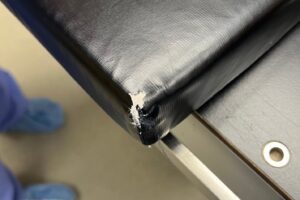
The first issue is surface cleaning and disinfection, using low level disinfection for items near the patient, and frequently touched surfaces. The article reminds readers that furniture and equipment that will be cleaned must be in good condition to be cleaned. We see very frequently that staff are attempting to clean torn, exposed and noncleanable/absorbent surfaces that first must be repaired or replaced in order to be cleanable. Although not mentioned in the article we also frequently see staff that are not using the organizations approved cleaning chemicals or they are not familiar with proper application of the approved chemical and dwell time on the surface.
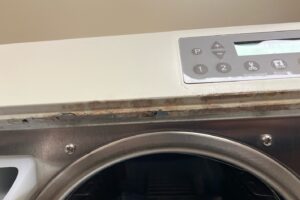 The second environmental issue discussed is medical device reprocessing and the daily, weekly and monthly maintenance of sterilizers. While we often think of the staff training and competence requirements that will be evaluated, the physical maintenance of the equipment and proper chemical or thermal requirements are equally complex. EC News warns readers that gaps in maintenance of sterilizers or other high risk and complex equipment for high level disinfection does often result in an immediate threat type situation.
The third warning area is ventilation and 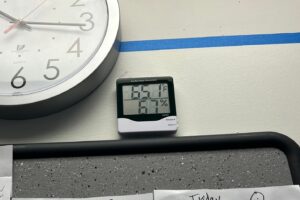 air quality which includes air pressure relationships, temperature, and humidity requirements. EC News also reminds us that it is not just operating and procedure rooms that have requirements, but also spaces such as sterile storage. As consultants, when we get involved in clarification or adverse decision appeals, it is rare that maintaining temperature, humidity, or air pressure relationship findings is not part of the problem set.
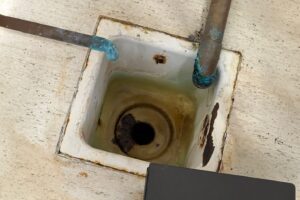
The fourth reminder about physical issues related to infection prevention is water management, which worst case outcome could result in an outbreak of legionella. Problems in this area do not occur with the same frequency as ventilation or sterilization issues, however the impact, should a legionella outbreak occur is like unleashing the mythical “hounds from hell” with patient and community impact as well as the many inspection agencies and adverse press reports that your organization will experience. EC News reminds readers of the requirements for water program leadership, basic water diagram to map flow, water management plans to evaluate physical and chemical conditions including dead legs, or stagnation, evaluating patient populations at greatest risk and water monitoring requirements.
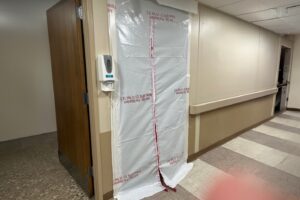 The fifth reminder is about controlling infection risks during construction. This starts with a preconstruction risk assessment and infection prevention risk assessment, which we sometimes see missing, but more often implementation of preventative measures to ward off the foreseen potential problems have not been adequately implemented. The key is to be observing the job site for deviation from expectations and correcting such deviations long before a surveyor notes them. There is an additional article in this month’s EC News about construction safety precautions that includes another of the JCR Toolbox checklists, this one a Daily Construction Site Safety Inspection Checklist. A link to this potentially very useful tool is provided in the last EC News article.
Interim Life Safety Measures (ILSM):
This month’s issue of EC News also includes a review article on ILSM requirements. Over many decades this has been a difficult to understand and frequently scored standards requirement. The standard now resides at PE.03.02.01, EP 1 and requires hospitals to have a written policy indicating which interim life safety measures will be implemented during periods when NFPA life safety code is not met and during periods of construction. EPs 2-14 then detail some potential implementation options you might use to provide comparable safety until code compliance can be re-established.
 Part of the confusion with this standard is that in the past people only thought of this for big construction projects, then years later it became evident it was also applicable to smaller renovations and more recently any life safety code defect you or a JC surveyor identifies as noncompliant. If a defect exists, you should be evaluating that defect to determine what ILSMs you will be implementing in order to maintain comparable safety.
It would be good to share this article with facilities leadership and verify that your policy, your ILSM evaluation tool, ILSM implementation and documentation practices are thorough.
Alcohol Based Hand Rub (ABHR):
Lastly, the April EC News includes an article reminding us of all the detailed requirements for safe use of alcohol based hand rub that are derived from NFPA requirements, which used to be in the standards prior to 2026. These details can still be identified in the 2026 Survey Process Guide.
 The article reminds readers of the following requirements:
- “The alcohol based hand rub (ABHR) must not be more than 95% alcohol”
- “Dispensers in rooms, corridors and areas open to corridors must not contain more than 0.32 gallons. Suites dispensers must not have more than 0.53 gallons ABHR.”
- “Cannisters of ABHR aerosols must not hold more than 18 ounces regardless of location”
- “Only level 1 (lowest risk) ABHR aerosols are permitted.”
- “A maximum of 10 gallons of liquid ABHR and level 1 aerosols are permitted to be stored outside of a storage cabinet in a single smoke compartment.”
- “If more than 5 gallons of fluid ABHR are stored in a single smoke compartment, a healthcare facility must comply with NFPA 30-2012.”
- “Dispensers must release ABHR only when activated and only in appropriate amounts for single use.”
- “Touch free ABHR dispensers must operate only when activated and only in appropriate amounts for single use.”
- “If hands or objects remain under the automatic dispenser for a prolonged period, the ABHR dispenser must release only the amount needed for one use.”
- “ABHR dispensers must be installed, tested, refilled and maintained according to the manufacturer’s instructions. “
- “ABHR dispensers are allowed in corridors that are at least 6 feet wide. There must be at least 4 feet of space between dispensers, and they may not be installed within 1 inch of an ignition source. “
- “Only in sprinklered compartments are ABHR dispensers permitted directly over carpet.”
- “ABHR dispensers must be protected against inappropriate use (pediatrics or ingestion).”
As you can see there are many important details for a seemingly simple device such as an alcohol gel dispenser. One general tip we would suggest is that whenever you see a standards reference that says per NFPA is to look for the details in either the specific NFPA reference or at least, in JC’s Survey Process Guide.
 DNV:
DNV:
Healthcare Symposium:
Their March monthly healthcare update was posted to their LinkedIn site and discusses the upcoming Healthcare Symposium in Nashville April 21-23. This educational program will be held a second time in Denver on July 21-23. Take a look at their DNV Health Hub LinkedIn newsletter for additional details.
 ISO Survey:
In our CMS section of this Patton Post, we discuss a new QSO memo detailing how CMS and accreditors should function when an organization loses deemed status. CMS recommends that the accreditor not conduct an accreditation survey during this time, however CMS advises that accreditors could continue ISO surveys or certification surveys that don’t have deemed status recognition.
ACHC:
 Facility Claims and Reimbursement:
ACHC posted a Regulatory Update to a CMS administrative announcement related to facility claims and reimbursement. We found the information interesting because administrative claims processing is not anything we routinely examine. It appears that CMS will be phasing out US mail and fax transfer of any supplemental information to support the claim.
 ACHCU MRI Coffee Chat:
Coffee Chat is an exclusive customer benefit (10 sessions per year) that is opening up to the public for this very important session on MRI Safety, with leading expert, Tobias Gilk, MRSE, MRSO. This upcoming session will be held on April 29 from 10- 11am ET. Register for the Building a Sustainable MRI Safety Program.
CMS had a busy March, posting three (3) new QSO memos and one (1) revised memo originally from 2018.
Organ Procurement and Transplant Organizations:
The first memo is QSO 26-05 issued March 11 is for organ procurement organizations and transplant organizations. It discusses in significant detail the general roles and responsibilities for the OPO and hospitals and provides more focused guidance on the consent and declaration of death processes. CMS has developed training materials and posted them to their Quality, Safety and Education Portal. Training materials are designed for state surveyors but may be of interest to participating hospital staff also.
 The second memo is QSO 26-06 was also issued on March 11 and is intended for organ procurement organizations. Their regulations are published in what CMS calls Appendix Y, and a revised Appendix Y is attached to the QSO memo. The changes are focused on two issues; the modifications to the survey process and revised interpretive guidance published as a result of the 2021 OPO final rule.
Deemed Status:
The third memo, issued on March 25 is the revision of an earlier memo first published in January 2018, QSO-18-12. This is an important memo of interest to all provider types using accreditation for deemed status. It discusses the interactions and responsibilities of CMS and the accreditor if CMS removes deemed status from the accredited organization. CMS identifies that if they remove deemed status from an organization due to CMS identifying significant noncompliance, and that organization becomes due for an accreditors resurvey, they will not recognize an accreditor’s redeeming survey.
They advise the accreditors to postpone any resurveys while deemed status is revoked. CMS also indicates that they will not consider such accreditor delays noncompliant with CMS resurvey deadlines. Accreditors may need to make their own decisions about conducting non-deemed surveys if they are concerned about the accredited organization remaining accredited, while substantial problems exist.
In the past there have been media reports about discordant survey results and accreditors may feel vulnerable if they don’t conduct their own reviews of organizations with major CMS noncompliance problems. As mentioned in our DNV section of this newsletter, CMS has no prohibitions or advice to delay surveys that are not deemed such as ISO surveys or certification surveys.
You might wonder under what circumstances might CMS remove deemed status. The revised QSO states that “CMS may remove the deemed status of a provider or supplier accredited under a CMS approved accreditation program when a state agency or federal survey team identifies condition-level non-compliance during a survey.” The earlier memo from 2018 said essentially the same thing but expressed differently. At that time CMS stated, “CMS may temporarily remove deemed status when a state agency or federal survey identifies condition-level non-compliance in a deemed provider or supplier, during either a representative sample or substantial allegation survey.”
When CMS might remove deemed status can be confusing because the code of federal regulations refers only to “validation surveys.” However, the definition of validation surveys in CFR 42 488.9 describes a validation survey as either a representative sample, or in response to substantial allegations. The identification of condition level findings also places the organization on what is called a “termination track,” which is 23 days for immediate jeopardy findings and 90 days for condition level findings.
This deemed status memo also includes important guidance on investigating new or additional complaints at an accredited organization where deemed status has already been temporarily suspended. In this situation CMS advises that the accreditor send any complaints they independently receive to the state agency and CMS within two (2) days. CMS indicates that they will let the accreditor know if they conducted an investigation and what they results were. If CMS does not investigate the complaint, they advise the accreditor to investigate once deemed status is restored.
 One changed process that looks like an improvement is that if the accreditor and CMS simultaneously receive the same complaint, they recommend the accrediting organization and state agency collaborate to avoid duplicating the same investigation. CMS also indicates that the state agency will determine the significance level of the complaint and make a determination on who should investigate. This coordination of effort may help reduce dual investigations of the same issue.
Lastly, if the accreditor receives a complaint that the accreditor triages at an IJ level, they require the accreditor to send that complaint to the state agency within two (2) business days.
Do take a careful look at this important modification to the complaint investigation processes.
Maternal Safety & Emergency Services:
The fourth is QSO 26-07, dated March 27, 2026, and it provides the anticipated interpretive guidance we discussed last month for hospital and critical access hospital emergency services in general, and emergency services for pregnant, birthing, and post-partum patients. This issue was first announced through a Federal Register posting back on November 27, 2024.
We noted one significant difference between this guidance and the prior (2025) Joint Commission standards for maternal safety. Those JC standards addressed care on labor and delivery units, whereas these CMS expectations address emergency services. Thus, hospitals and critical access hospitals that may not have focused on this issue earlier because they did not have a labor and delivery unit, will now need to comply with these CMS expectations.
CMS tempers this focus somewhat in tag A-1114 for hospitals and C-0896 for CAHs by saying: “in accordance with the complexity and scope of services offered, there must be provisions…. and protocols to meet the emergency needs of patients.” It’s not clear what that modifier statement means, but we assume it may be duration of the emergency care prior to effecting a safe transfer of a stable patient.
Two sets of interpretive guidance have been posted, one for CAH and one for hospitals. The regulatory reference numbers differ, but upon first read the content looks is very similar, except for the sections on supplies and equipment.
The regulations became effective July 1, 2025, without interpretive guidance, so if you did not prepare earlier, you will want to expedite readiness now. The first directive is that the facility should have protocols as described above. Then ten (10) examples of applicable emergencies are listed, as “may include, but not limited to.”
The examples which are identical between CAH and hospitals are:
- Cardiac arrest
- Stroke
- Trauma, including pediatric trauma
- Sepsis
- Respiratory distress
- Obstetric complications such as hemorrhage, preeclampsia, uterine rupture
- Neonatal resuscitation and other newborn care emergencies
- Obstetric emergencies during labor and delivery such as shoulder dystonia, cord prolapse, emergency cesarean delivery, etc.
- Postpartum care and complications
- Any other medical emergencies that could arise in the obstetrics unit
CMS provides examples of recognized clinical practice guidelines, as “including but not limited to,” that should form the basis for your facilities emergency protocols for medical and surgical emergencies such as: American College of Emergency Physicians, Advanced Trauma Life Support, and the American Heart Association. Similarly, for obstetric emergencies they reference American College of Obstetricians and Gynecologists, Society for Fetal Medicine, and the American Academy of Pediatrics.
The CMS memo then provides the survey procedures, detailing what surveyors should look for during a survey to assess tag A-1114 for hospitals and tag C-0896 for CAH. Surveyors are advised to review the protocols to verify they address the full array of emergencies previously mentioned. They also advise surveyors to verify that the guidelines incorporated in facility protocols are the most recent guidelines from the issuing professional society. Surveyors are also instructed to interview staff and review medical records for emergency care to determine if the protocols are properly implemented. Facilities will want to self-evaluate compliance for QAPI purposes.
A second tag A-1115 for hospitals, and still under one tag C-0896 for CAH, next describes the supplies and equipment that should be available to meet the emergency needs of patients. These requirements do differ between CAH and hospitals in the level of detail.
 A critical access hospital must have supplies and equipment as “in accordance with the CAH’s protocols.” In addition, the CAH must have emergency kits, “e.g. OB hemorrhage carts, imminent birth carts, neonatal resuscitation stations, clearly labeled, stocked and accessible.” The acute hospital section has more detail as to the expectations for supplies and equipment. CMS specifically mentions having access to drugs, blood and blood products and they provide an extensive list of such products that should be available. Similarly, they require access to equipment and supplies commonly available for life saving procedures including any specialized equipment called for in your chosen clinical practice guideline.
The acute hospital interpretive guidance also has detailed expectations for emergency call systems from patient to the nursing station. CMS also details an expectation for staff to be able to summon additional support and resources through a call in or alert system.
CONSULTANT CORNER
Dear Readers,
We hope this month finds you well. At Patton Healthcare Consulting and Barrins & Associates, we remain focused on delivering experienced, practical support to organizations navigating today’s complex regulatory landscape.
This month, we’re pleased to welcome Laurie Farmer, MSN, RN, Principal Consultant and David Major, PE, CHC, CHFM, Consultant to our consulting team—further expanding the depth and breadth of expertise available to the organizations we serve.
Please join us in welcoming Laurie and David!

Laurie Farmer, MSN, RN
“I’m excited to join the HBS, Patton , and Barrins consulting team. Building on years of national consulting and survey experience, I look forward to partnering with healthcare organizations to strengthen readiness, advance quality and patient safety, and support meaningful, lasting improvement alongside this talented team.”
Want to connect?
(770) 354-7992
Laurie.Farmer@HBSinc.com

David Major, PE, CHC, CHFM
“Joining the HBS, Patton, and Barrins team is a great opportunity to continue serving healthcare organizations through education, planning, and sustainable operational readiness. I look forward to helping clients navigate evolving compliance challenges with practical solutions in facilities, construction, emergency management, and life safety.”
Want to connect?
(484) 269-3771
David.Major@HBSinc.com
Julia Finken, RN, BSN, MBA, CPHQ, CLSSMBB
Julia.finken@hbsinc.com
Jen Cowel, RN, MHSA
jencowel@pattonhc.com
Laurie Farmer, MSN, RN
laurie.farmer@hbsinc.com